

Figures (Includes Tables)

Subtitle
Abstract
Introduction
Weight reduction is one of the most important objectives in aerospace engineering. A reduction in aircraft structural weight can decrease fuel consumption, increase payload capacity, improve flight performance, and reduce greenhouse-gas emissions. For this reason, aerospace engineers have increasingly explored materials that provide high mechanical strength at significantly lower weight than conventional metals.
Carbon-fiber-reinforced polymer (CFRP) is one of the most important advanced composite materials used in modern aerospace applications. CFRP consists primarily of carbon fibers embedded within a polymer matrix. The carbon fibers provide high strength and stiffness, while the polymer matrix binds the fibers together and transfers loads between them.
Compared with conventional aluminum alloys, CFRP offers a significantly higher strength-to-weight and stiffness-to-weight ratio. It also provides excellent resistance to corrosion and fatigue. These properties make it suitable for aircraft wings, fuselage structures, tail assemblies, control surfaces, and other components.
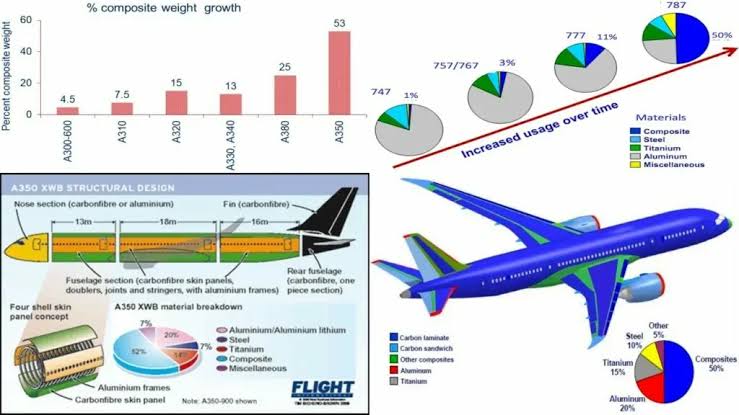
Modern commercial aircraft have demonstrated the increasing importance of composite materials. Aircraft such as the Boeing 787 Dreamliner and Airbus A350 XWB use substantial amounts of composite material in their primary structures. The increased use of composites has consequently changed aircraft design, manufacturing processes, inspection methods, and maintenance practices.
Despite these advantages, composite materials also introduce challenges. Manufacturing CFRP components can be expensive and technically complex. Composite structures can experience internal damage that is difficult to detect through conventional visual inspection. Repair procedures can also differ considerably from those used for metallic structures. Furthermore, end-of-life recycling of carbon-fiber composites remains a major sustainability challenge.
Therefore, understanding both the benefits and limitations of CFRP is important for the future development of lightweight and sustainable aerospace structures.
Research Questions and Methodology
5.1 Research Questions
This study focuses on the following research questions:
- How can CFRP composites improve the weight efficiency of aircraft structures?
- What mechanical and environmental advantages do CFRP materials provide compared with conventional aerospace metals?
- What are the major manufacturing and maintenance challenges associated with CFRP structures?
- How can future technologies improve the sustainability and reliability of composite aircraft components?
Figure 1
5.2 Research Method
This research follows a literature-based comparative research methodology. Relevant research papers, aerospace engineering publications, technical reports, and publicly available information regarding composite materials were reviewed.
The analysis focuses on five major performance areas:
- Weight efficiency: Comparison of material density and structural efficiency.
- Mechanical performance: Strength, stiffness, fatigue resistance, and damage tolerance.
- Environmental performance: Corrosion resistance and potential effects on aircraft fuel consumption.
- Manufacturing: Production complexity, joining methods, and quality-control requirements.
- Maintenance and sustainability: Inspection, repair, recycling, and end-of-life considerations.
The findings from different studies were compared to identify the major advantages and limitations of CFRP in aerospace applications.
Results and Discussion
The most significant advantage of CFRP is its high strength-to-weight ratio. Carbon fibers possess high tensile strength and stiffness while having relatively low density. This allows engineers to design lighter structural components without sacrificing required mechanical performance.
Reducing aircraft structural weight can have a direct influence on fuel consumption and payload capacity. A lighter aircraft requires less energy to maintain flight, particularly during cruise and climb operations.
However, the actual weight reduction depends on the aircraft design, material configuration, manufacturing technique, and structural requirements. Composite materials do not automatically produce weight savings in every application.
Conclusion
Advanced composite materials, particularly carbon-fiber-reinforced polymers, have become an important part of modern aerospace engineering. Their high strength-to-weight ratio, stiffness, fatigue resistance, and corrosion resistance make them highly suitable for aircraft structural applications.
The research indicates that CFRP can contribute significantly to aircraft weight reduction and improved operational efficiency. However, the benefits are accompanied by challenges involving manufacturing cost, inspection, repair, damage detection, and recycling.
Future research should focus on developing lower-cost manufacturing processes, improved damage-detection technologies, recyclable composite systems, and more sustainable production methods. The integration of advanced manufacturing, artificial intelligence, structural-health monitoring, and recyclable materials could further expand the role of composites in next-generation aircraft.
Overall, advanced composite materials are expected to remain a critical technology in aerospace engineering as the industry moves toward lighter, more efficient, safer, and environmentally sustainable aircraft.

No comments yet.